Japanese Knife Steel Explained: VG-10, SG2, and Blue Steel Compared
Affiliate disclosure: As an Amazon Associate I earn from qualifying purchases. Purchases through affiliate links may earn a commission at no extra cost to you.
Updated September 20, 2026. This is an editorial comparison based on the manufacturer and official sources linked below. Recommendations reflect the buying criteria explained here; they are not results of a WabiFinds hands-on test.
VG-10 vs SG2 for a home kitchen: VG-10 is a sensible stainless shortlist when budget matters; SG2 is worth considering when you value wear resistance and the complete knife fits your hand and sharpening routine. Neither label guarantees better cutting. Blade geometry, heat treatment, edge condition and your cutting board all affect the result.
Japanese Knife Steel: A Buying Comparison
| Steel | What the name tells you | Main buying trade-off | Ask the seller |
|---|---|---|---|
| VG-10 | A stainless blade steel from Takefu | A practical stainless starting point; compare the full knife price | Exact model, stated hardness and blade thickness |
| SG2 / Super Gold 2 | A powder-metallurgy steel from Takefu | Consider when wear resistance matters; do not pay for the name alone | Heat treatment, edge geometry and sharpening advice |
| Blue / Aogami | A family of non-stainless carbon steels | Choose only if regular wiping and prompt drying fit your routine | Which Blue grade, and whether the cladding is stainless |
| White / Shirogami | A family of simpler non-stainless carbon steels | A carbon-steel option, not an automatic sharpness winner | Which White grade, bevel type and maintenance requirements |
This table is a buying framework, not a measured league table. There is no single HRC number for an entire steel family: hardness belongs to the finished knife and its heat treatment. A steel name alone also cannot tell you how many weeks an edge will last.
What Is VG-10 Steel?
Takefu’s VG-10 information identifies a stainless cutlery steel containing chromium, molybdenum, vanadium and cobalt. Its composition table gives representative chemistry, not a performance certificate for every finished knife. For a buyer, the useful next step is to check the maker’s model specification and care instructions.
VG-10 makes a reasonable starting filter when you want a stainless knife, but it does not settle length, handle comfort or whether the blade is thin behind the edge. Compare those details before spending more on a decorative finish. Keep part of the budget for a suitable board and a sharpening plan rather than using every dollar on the blade.
VG-10 vs SG2: What Changes, and What Does Not?
Takefu lists Super Gold 2 as a powder-metallurgy steel. Its current public composition table does not disclose the formula, so this guide does not present an unofficial recipe as a maker specification. If a retailer uses R2 or a combined R2/SG2 label, check the actual manufacturer’s specification for that knife.
Metallurgist Larrin Thomas’s VG-10 and SG2 investigation includes experiments on toughness and corrosion. It estimates higher wear resistance for SG2, but explicitly does not report a measured SG2 CATRA edge-retention result in that article. That distinction matters: an estimate is not a head-to-head kitchen test, and WabiFinds has not measured these knives itself.
Use that evidence as a reason to consider SG2, not a promise that every SG2 knife outlasts every VG-10 knife. A thinner blade can move through food differently from a thicker one even when both have the same steel. Ask what you want to improve about your current knife—effort through vegetables, maintenance, balance or sharpening frequency—before deciding a new steel is the answer.
Blue Steel vs White Steel: Start With the Care Requirement
Blue and White refer to families of grades, not two universal hardness values. Proterial’s published materials table lists chromium and tungsten in Aogami 2 while White 1 is a simpler carbon grade. Neither should be purchased on the assumption that it behaves like a stainless kitchen knife.
For the buyer, the first decision is whether you will wipe the blade during preparation and wash and dry it promptly. Check both the core and cladding: stainless sides do not turn an exposed carbon-steel edge into a stainless edge. Ask the maker about longer-term storage rather than applying a generic care rule to an unfamiliar finish.
White steel is not automatically the sharpest possible choice, and Blue steel is not a guarantee of longer useful edge life. The grade number, heat treatment, edge angle and sharpening quality matter. If maintenance already feels like a burden, choose a stainless model you will care for consistently instead of a carbon knife bought for prestige.
Four Checks More Useful Than a Steel Ranking
1. Compare the exact models. Write down blade length, weight, handle material and whether the knife has a single or double bevel. Compare like-for-like sizes and include local warranty or sharpening support in the decision.
2. Ask for the maker’s stated hardness. HRC is one specification, not a complete measure of toughness or cutting quality. Do not copy a generic range for a steel onto a product whose maker gives a different figure.
3. Match the shape to your tasks. A steel upgrade will not solve a blade that is too long for the working space or a shape that does not suit your chopping motion. Start with santoku vs gyuto vs nakiri if the shape is undecided.
4. Plan the care system. Use the cutting board comparison to choose a surface you can clean and store, then the whetstone grit guide for sharpening equipment. A premium alloy is not a reason to start on an unnecessarily fine polishing stone.
Frequently Asked Questions About Japanese Knife Steel
Does stainless mean I can leave the knife wet? No. Follow the knife maker’s washing and drying instructions. Stainless is a corrosion-resistance category, not permission to soak a blade or put every knife in the dishwasher.
Do I need a finer stone for SG2? Steel alone does not select the grit. A dull or damaged edge needs an appropriate sharpening step before polishing; use the whetstone sharpening guide and the maker’s instructions. Do not equate higher grit with faster restoration of a dull edge.
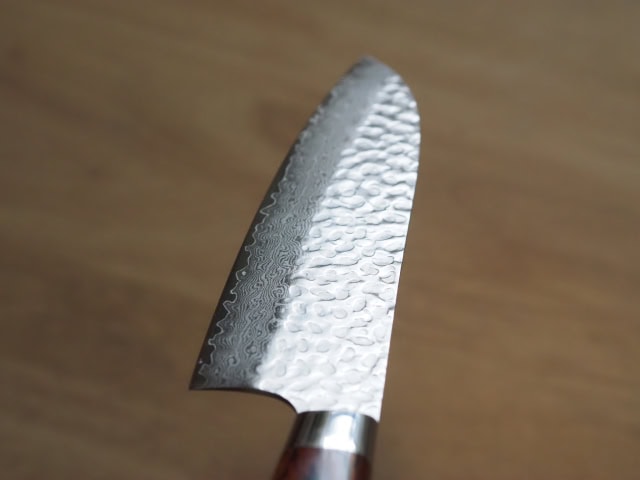
Does Damascus prove the knife is better? A visible layered pattern is not a measured cutting result. Check the cutting steel and the construction of the exact knife. Judge the pattern as part of the design you like, rather than an edge-retention score.
Which Japanese Knife Steel Should You Choose?
Shortlist VG-10 if you want a straightforward stainless comparison, consider SG2 when its complete specification justifies the price for you, and consider Blue or White only with a realistic carbon-steel care routine. Then compare actual products in the Japanese kitchen knife buying guide. This approach keeps the purchase tied to your kitchen rather than an assumed hierarchy of steel names.