Best Japanese Kitchen Knives for Home Cooks (Not Just Chefs)
Affiliate disclosure: As an Amazon Associate I earn from qualifying purchases. This article contains affiliate links; purchases may earn a commission at no extra cost to you.
For a first Japanese kitchen knife, start with the blade shape and length you can comfortably control, then compare the exact model and handle. A 200–210 mm chef’s knife is one option for general preparation; a shorter blade may suit your board or grip better. You do not need to buy a complete matching set.
This is a research-based shortlist using manufacturer information, not a hands-on cutting test. Recommendations below describe reasons to consider a model and checks to make before buying. They do not claim measured superiority or resistance to chipping.
Best Japanese kitchen knives for home cooks: a practical shortlist
| Model or range | Verified distinction | Check before choosing |
|---|---|---|
| TOJIRO CLASSIC F-808 | 210 mm blade; VG10 core; reinforced laminated handle; double bevel | Do not confuse F-808 with a retailer listing for FU-808. |
| MAC Professional MTH-80 | Manufacturer lists a 7.88-inch blade, 2.5 mm blade thickness and 6.5 oz weight | Try the handle and overall length; dimples do not guarantee that food never sticks. |
| Shun Classic 8-inch chef’s knife | Shun identifies a VG-MAX steel core for this model | Check handle comfort and the exact Classic model; other Shun ranges differ. |
| MIYABI Kaizen 8-inch chef’s knife | Maker describes a VG10 core and D-shaped Micarta handle | Kaizen and Kaizen II/Artisan listings are not automatically interchangeable. |
| GLOBAL G-2 | 20 cm general-purpose blade with an all-metal handle design | Handle feel is a personal fit decision; try it where possible. |
TOJIRO: confirm the model number first
The official F-808 specification gives a 210 mm blade, 335 mm total length and 200 g weight. The maker identifies a VG10 core, stainless outer layers and a reinforced laminated handle. Those specifications describe F-808.
The existing Amazon option below is labelled FU-808/Fujitora. Treat that as a separate product identification and confirm the seller’s specification; this guide does not establish that it is identical to F-808. If you want the maker-documented F-808, use that full model number when shopping.
Check the Fujitora FU-808 210 mm listing on Amazon.com
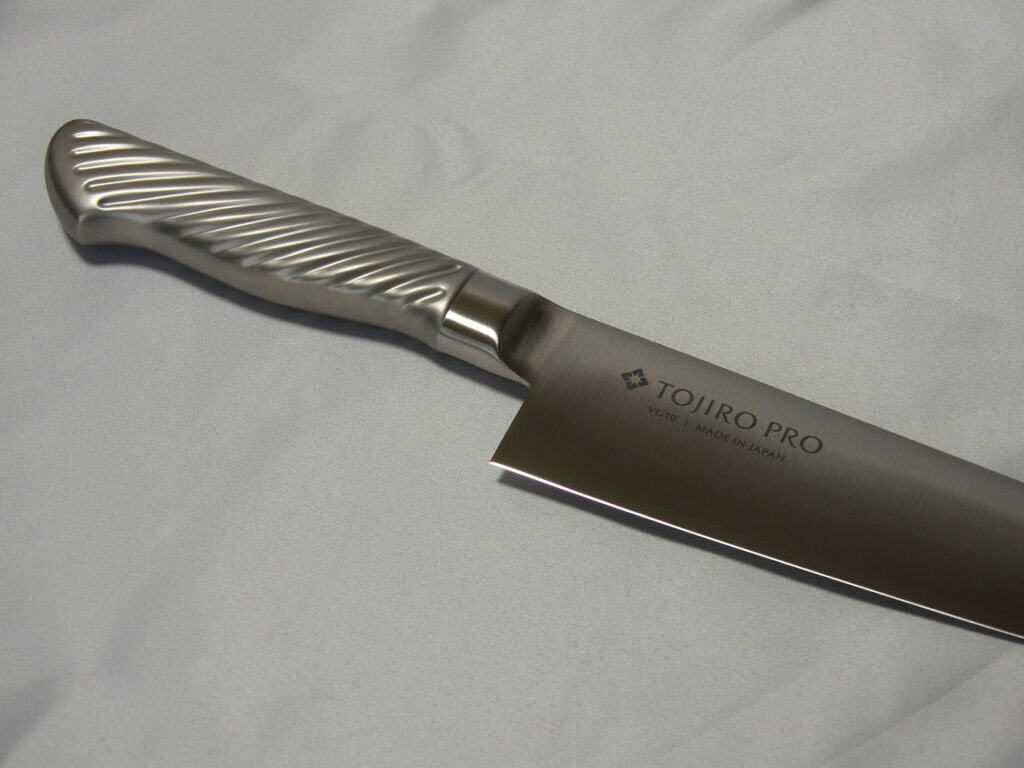
MAC MTH-80: compare the dimensions with your current knife
The manufacturer’s MTH-80 page lists the length, thickness and weight shown in the table. Use those figures to compare with a knife you already find comfortable. A thinner profile or different balance will not feel better to every cook.
This is a candidate for someone who wants a conventional chef’s-knife format with a separate handle and bolster. Check the return policy if you cannot handle it before ordering, and avoid assuming that its dimples eliminate food adhesion.
Shun Classic: choose the exact blade and handle
Shun’s Classic 8-inch guide identifies VG-MAX core steel for this option. Compare the blade length and grip with other Classic sizes rather than choosing solely for the patterned appearance. A decorative finish is not a cutting-test result.
For a gift, confirm the recipient’s preferred blade size and whether they can exchange the knife. Keep enough of the budget for appropriate storage and sharpening.
View Shun Classic 8-inch chef’s knife on Amazon.com
MIYABI Kaizen: check the series as well as the size
The Kaizen 8-inch product page describes a VG10 core, Damascus appearance and D-shaped Micarta handle. Similar names can appear across different MIYABI lines, so match the product number before transferring specifications from one listing to another.
Consider it if that handle shape and finish appeal to you. The question to settle in person is grip comfort, not whether a higher price makes it automatically more precise in your kitchen.
GLOBAL G-2: a different handle to try
The GLOBAL G-2 description identifies a 20 cm blade for general preparation and CROMOVA 18 stainless steel. Its metal handle gives you a different grip surface from the other options here. That difference makes handling it before purchase especially useful.
Do not treat stainless construction as permission to leave a knife wet or in a sink. Follow the maker’s care instructions for the exact model.
Photo: Javaweb / Wikimedia Commons · CC BY-SA 3.0. Resized/compressed; no content edits.
A five-minute fit check before buying
- Choose the task: general preparation, vegetables or long slicing cuts. Start with the santoku, gyuto and nakiri comparison if the shapes are unfamiliar.
- Check your board: allow room for the blade and food without working near an unstable edge.
- Try the grip: check finger clearance, handle shape and whether you can lift and lower the blade comfortably. Ask the retailer before handling a display knife.
- Match the listing: product code, blade length and handle must agree with the model you researched.
- Budget for ownership: include a suitable board, storage and sharpening, not only the knife price.
Care is part of the purchase
Follow the manufacturer’s instructions. Hand-wash and dry promptly, use a suitable cutting surface and protect the edge in storage. Avoid twisting the blade through hard food, bones or frozen ingredients unless the maker specifically designs it for that task.
Our cutting board guide helps compare board choices. Use the whetstone guide for a sharpening setup and the knife storage comparison for drawer guards, blocks and magnetic storage. Sharpen according to condition and use, not a universal calendar interval.
Buying in the US, UK, Australia and Canada
The affiliate links here point to Amazon.com in the US. For other markets, compare local sellers and the manufacturer’s regional support terms. Check delivery, applicable import charges, returns and the exact product code. Neither a current price nor worldwide delivery is guaranteed by this guide.
Frequently asked questions
Is a more expensive knife always better for a beginner?
No. Fit, intended tasks and maintenance matter. A handle or blade length you dislike is not corrected by a more elaborate finish.
Does VG10 mean two knives perform identically?
No. Blade geometry, heat treatment, handle and condition also matter. Read our Japanese knife steel guide before using an alloy name as a ranking.
Should I start with a set?
Begin with the tasks your existing tools do not cover well. One suitable main knife may be more useful than several overlapping shapes.
Which is the best choice without trying them?
There is no reliable universal winner. Shortlist by dimensions and handle, then choose a seller with clear product identification and a return policy you understand.