The Niigata Sake Gift Guide: 5 Bottles Worth Bringing Home (Kubota, Hakkaisan, Shimeharitsuru, Koshino Kanbai, Kikusui Compared)
Affiliate disclosure: As an Amazon Associate I earn from qualifying purchases. This article contains affiliate links; purchases may earn a commission at no extra cost to you.
This Niigata sake gift guide compares Kubota, Hakkaisan, Shimeharitsuru, Koshino Kanbai and Kikusui. Start with the recipient’s tastes, then compare the bottle style and your total budget.
Introduction
You’re standing in a liquor shop in Niigata, or maybe scrolling a shelf at Narita’s duty-free, and the sake wall in front of you might as well be written in a language you don’t read — because, well, it is. Every bottle has a crane, a mountain, or a calligraphy label that looks equally “authentic,” and the clerk is busy with someone else. You’ve got a flight to catch, a friend back home who “likes sake” but has only ever had the hot stuff from a conveyor-belt sushi place, and maybe $40 to spend on something that says I thought about you specifically rather than I grabbed whatever was closest to the register.
I’ve been that person. The first time I tried to bring sake home from Niigata, I bought a bottle because the label had a snowy mountain on it and I thought it looked “wintery and Japanese enough.” It turned out to be decent, but I later learned I’d walked past three bottles that would have meant a lot more — one of them a brewery my host family in Niigata had been quietly proud of for three generations.
Niigata isn’t just “a sake region” — it’s arguably the sake region if you care about the clean, dry, almost snowmelt-crisp style called tanrei karakuchi (淡麗辛口). The prefecture’s heavy snowfall, soft mountain water, and rice-growing tradition (this is Koshihikari rice country, after all) all push local brewers toward a drier, lighter, more refined style than you’ll find in, say, the richer sakes of Kyushu. That’s useful context, but it doesn’t solve your actual problem: which bottle do you buy, for which person, at which price? (For more on the region’s brewing history, the Niigata Sake Brewers Association is the definitive source.)
This guide compares five of Niigata’s most recognized names — Kubota (久保田), Hakkaisan (八海山), Shimeharitsuru (〆張鶴), Koshino Kanbai (越乃寒梅), and Kikusui (菊水) — with an eye specifically toward gifting. Not “best sake of all time” lists. Not brewery history lectures. Just: here’s what each one tastes like, here’s what it costs, here’s who should actually receive it, and here’s where you can realistically find it.
Who This Article Is NOT For
Before we go further, let me save you some time if you’re not actually the reader I have in mind.
If you’re a serious sake collector chasing rare, limited-release junmai daiginjo, this article will feel too basic. I’m not going to walk you through polishing ratios below 35% or debate yeast strains. There are better resources — and honestly, better people than me — for that conversation.
If you want the cheapest possible bottle just to check a box, this isn’t really a “gift guide” problem, it’s a budget problem, and I’d rather be honest that Kikusui’s small cans (more on those shortly) solve that need better than anything else on this list.
If your recipient doesn’t drink alcohol or actively dislikes rice wine, please don’t force a sake gift on them because it seems culturally appropriate. I’ve watched well-meaning travelers hand over beautiful bottles to relatives who quietly regifted them. A nice matcha set or Niigata rice cracker (senbei) box travels just as well and won’t sit unopened in a cabinet for two years.
If none of that describes you, let’s get into it.
Selection Criteria: How I Picked and Judged These Five
I narrowed this down using three criteria, because “best sake” is meaningless without knowing what you’re optimizing for.
1. Recognizability without being generic. Every bottle here has genuine standing in Niigata’s sake history — none of them are mass-market filler — but I also wanted brands with enough of a story that you can say something interesting when you hand over the gift. “I picked this because it’s from the same brewery my train stopped near” lands a lot better than silence.
2. Realistic purchasability for a traveler. A gift you can’t actually buy isn’t a gift, it’s a daydream. I weighted heavily toward bottles you can find in an airport, a depachika (department store basement), a conbini in a pinch, or through international retailers if you’re reading this before your trip. I’ll flag the one entry here that’s genuinely difficult to find, because you deserve to know that before you spend an afternoon hunting for it.
3. Range across price points and occasions. A gift for your boss is not a gift for your college roommate. I made sure this list spans roughly $15 cans to $150+ bottles so there’s a legitimate option whether you’re being polite or being generous.
Niigata Sake Gift Guide: Quick Comparison
| Brand (Japanese) | Typical Price Range (USD) | Flavor Profile | Where to Find It Abroad | Best For |
|---|---|---|---|---|
| Kubota (久保田) | $30–$90 (standard lines); $75–$90+ for Manju | Clean, elegant, gently sweet-dry balance | Widely available; most major Japanese/Asian grocery chains and specialty liquor shops | The “safe impressive” gift — bosses, in-laws, formal occasions |
| Hakkaisan (八海山) | $25–$60 | Crisp, light, almost mineral-water clean | Very widely available, including many US/UK specialty retailers | Sake beginners and people who “don’t usually like sake” |
| Shimeharitsuru (〆張鶴) | $35–$80 | Rounder, slightly richer, more traditional rice character | Limited outside Japan/Niigata; best bought in-country | Sake enthusiasts and people who already know their stuff |
| Koshino Kanbai (越乃寒梅) | $60–$200+ (resale can run higher) | Delicate, restrained, famously subtle — the “less is more” sake | Rare outside Niigata; often allocation-only even within Japan | Serious gifts to serious sake people, and bragging rights |
| Kikusui (菊水) | $4–$15 (cans); $20–$40 (bottles) | Straightforward, approachable, slightly rice-forward | Extremely available — convenience stores, airports, most import stores worldwide | Casual gifts, group gifts, “thanks for having me” gestures |
(Related read: How to Read a Japanese Sake Label Without Speaking Japanese — useful if you want to double-check what you’re buying in-store.)
Individual Product Reviews
Kubota (久保田) — The One That Says “I Put Thought Into This”
Kubota is made by Asahi Shuzo, and if you’ve ever asked a Japanese colleague “what’s a good sake to bring as an omiyage (souvenir gift),” there’s a decent chance this is the name they said. The lineup runs in three tiers: Hyakuju, a clean, dry honjozo and the most accessible entry point; Senju, a ginjo-grade honjozo and the brand’s best-known workhorse bottle — often the first Kubota a new drinker tries; and Manju, the flagship junmai daiginjo, where the rice is polished down significantly for a noticeably more refined, layered taste.
In my experience, Kubota Senju (千寿) is the bottle I’ve watched non-sake-drinkers enjoy the most at a dinner table, because it doesn’t ambush anyone with an unfamiliar flavor. It’s dry, but not aggressively so, with a clean finish that doesn’t linger in a way that scares off beginners.
Pros:
- Consistent quality across the whole line, so you can trade up or down based on budget without disappointment
- Elegant bottle design that photographs and gifts well without looking flashy
- Easy to find — Senju in particular is genuinely one of the few Niigata sakes you can grab at a well-stocked liquor store outside Japan
Cons:
- Hyakuju, while a solid everyday honjozo, doesn’t showcase what makes Niigata sake special the way the pricier tiers do — it’s a fine starting point, not a showcase bottle
- Manju gets expensive fast, and at $75–90+, you’re competing with genuinely rare bottles from other breweries
Who it’s for: Your boss, your in-laws, a business partner, or anyone where “safe but clearly premium” is exactly the message you want to send. Senju is the natural default gift within the line; Hyakuju suits a more casual or budget-conscious gift, and Manju is reserved for genuinely special occasions.
Hakkaisan (八海山) — The Gateway Sake for People Who “Don’t Like Sake”
Hakkaisan brewery sits at the base of Mount Hakkai, and the sake genuinely tastes like it — crisp, almost weightless, with a clean mineral quality that I can only describe as “what melted snow would taste like if it had a personality.” This is, hands-down, the bottle I recommend to friends who tell me they only know sake from a hot flask at an izakaya and assumed it was all supposed to taste like rubbing alcohol with a headache attached.
I brought a bottle of the standard Hakkaisan Junmai Ginjo to a friend’s dinner party a few years back — someone who had told me flatly, “I don’t really do sake” — and watched her go back for a second pour before dessert. That’s basically become my litmus test for a good beginner-friendly bottle now.
Pros:
- Extremely approachable; possibly the best “convert a skeptic” sake on this entire list
- Good availability — I’ve seen it in specialty shops in the US, UK, and Australia, not just in Japan
- Reasonable price-to-quality ratio; you’re not overpaying for the name
Cons:
- Some sake enthusiasts find it a touch too clean — if your recipient wants something with more depth or umami, this might read as thin to them
- The brand has expanded so much (they also make shochu and even a sparkling sake) that the sheer range can be confusing if you’re shopping in person
Who it’s for: Anyone who’s hesitant about sake, a coworker who mentioned they “tried it once in Japan and didn’t love it,” or a lighter, warm-weather gift where you want something refreshing rather than heavy.
Shimeharitsuru (〆張鶴) — The One for People Who Actually Know Sake
This is the brand on the list most travelers have never heard of — and that’s exactly the point if your recipient is the kind of person who already owns a sake cup set and has opinions about serving temperature. Shimeharitsuru comes from the town of Murakami, in northern Niigata, and it leans a little rounder and more rice-forward than Kubota or Hakkaisan, without tipping into the sweetness you get from sakes further south.
I picked up a bottle of the Shimeharitsuru “Ginjo” at a small shop near Murakami station on a trip up the coast, mostly because the shopkeeper seemed personally offended that I hadn’t heard of it. She was right to be offended. It had a texture — almost a gentle creaminess on the mid-palate — that neither Kubota nor Hakkaisan gave me, while still finishing dry.
Pros:
- More distinctive flavor profile than the bigger, more “safely likeable” brands — a genuinely interesting bottle for someone who wants nuance
- Feels like a locals’ pick, which adds a nice story to the gift (“this is the one they actually drink in Murakami”)
- Generally well-priced for the quality, since it hasn’t been marked up by international brand recognition
Cons:
- Hard to find outside Niigata, and close to impossible outside Japan — you’ll likely need to buy it in-country, ideally in the Murakami/Niigata area itself
- Less recognizable name means the gift relies more on your explanation than the label doing the work for you
Who it’s for: Someone who already appreciates sake and would rather receive something they can’t just order online than another famous name they’ve already tried.
Koshino Kanbai (越乃寒梅) — The “Phantom Sake” for Serious Bragging Rights
If Shimeharitsuru is the locals’ pick, Koshino Kanbai is the legend. It’s sometimes called maboroshi no sake — “phantom sake” — because for decades demand outstripped supply so badly that it became something of a status symbol just to have a bottle, long before “hype culture” was a phrase anyone used for alcohol. Koshino Kanbai is widely credited as one of the brands that helped define the tanrei karakuchi style Niigata is now famous for, back when most of Japan still preferred heavier, sweeter sake.
Here’s the thing, though, and I want to be straight with you: the flavor itself is deliberately restrained. It’s subtle, almost quiet, and if you’re expecting a big, showy taste to match the reputation, you might actually be a little underwhelmed on first sip. I remember pouring this for a friend who does sake tastings professionally, and her first comment was “huh, that’s… polite,” before she explained that the reserved character is precisely the point — it’s built to complement food, not to dominate a room by itself.
Pros:
- Serious cultural cachet — for someone who knows sake history, this name means something immediately
- Genuinely refined, food-friendly flavor once you understand what it’s going for
- Makes an excellent story-driven gift, especially paired with an explanation of its “phantom sake” reputation
Cons:
- Difficult to find, even within Japan — some shops only get small allocations, and prices can be inflated by resellers
- The subtlety that makes it special can read as underwhelming to someone expecting bold or sweet flavors
- Not a great “grab and go” option; budget extra time to actually track down a bottle
Who it’s for: A serious sake enthusiast, a mentor or someone you genuinely want to impress, or a special occasion gift where the story matters as much as the liquid.
Kikusui (菊水) — The Practical, Always-Available Crowd-Pleaser
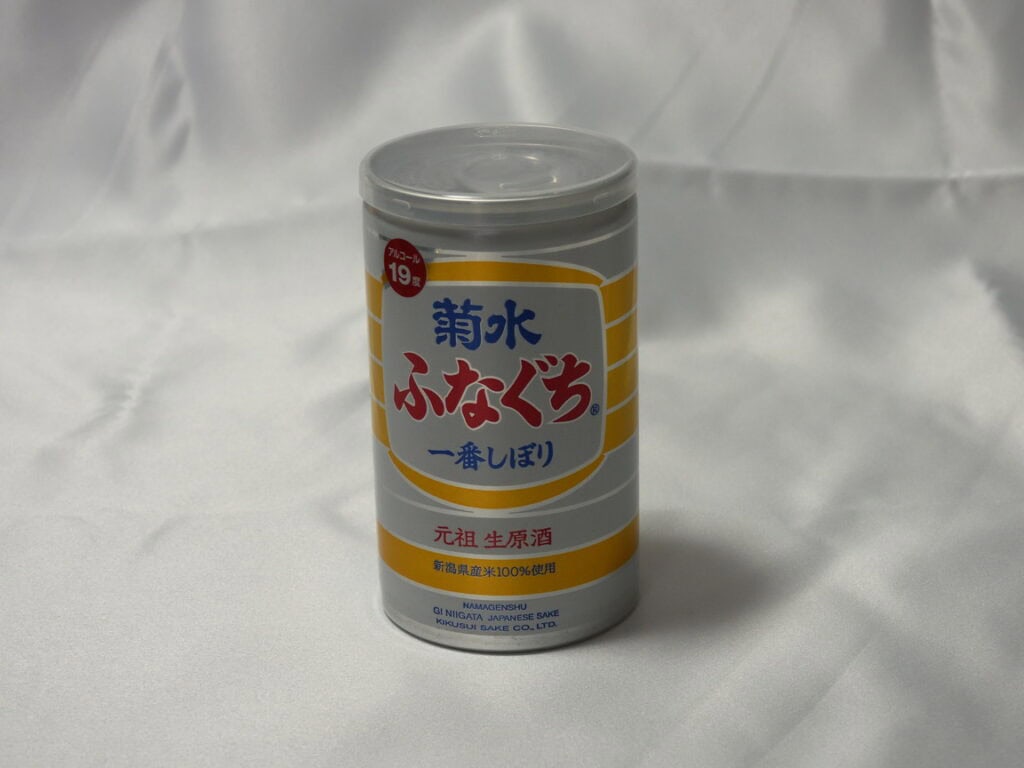
And then there’s Kikusui, which solves an entirely different problem: you need a gift now, it needs to travel well, and it can’t cost $80. Kikusui‘s white-and-gold can — Funaguchi — is one of the most recognizable sake products in Japan, sold in convenience stores, and it’s unpasteurized, which gives it a fresher, slightly more vivid flavor than you’d expect from something in a can.
I’ll admit my first Kikusui experience was accidental — I grabbed one from a conbini fridge at 11 p.m. after missing the last train, mostly because it was cold and cheap. It was better than I expected, in a “this is genuinely enjoyable, not just convenient” way, and I’ve since bought a six-pack of the small cans specifically as a “thanks for hosting me” gift for a group, since it lets everyone try a little without committing to a shared bottle.
Pros:
- Unbeatable availability — you can find this in airports, conbinis, and international grocery stores almost everywhere
- Cheap enough to buy in bulk for group gifts or as a “plus one” alongside a nicer bottle
- Fun format (the can) that feels novel to people who’ve only ever seen sake in glass bottles
Cons:
- Doesn’t carry the same prestige as the other four names — this is not the gift for someone you’re trying to impress
- The can format, while fun, can come across as a bit casual for a formal gift-giving occasion
Who it’s for: Group gifts, casual friends, a “thank you for the ride to the airport” gesture, or anyone where the gesture matters more than the price tag.
Photo: shankar s. · CC BY 2.0. Display size adjusted; no cropping.
Recommendation by Use Case
Since “best overall” isn’t really a useful answer here, let me break it down by who you’re actually shopping for:
Gifting to your boss or a business contact: Kubota (the Hyakuju or Manju tier, if budget allows). It signals effort and taste without needing explanation.
Gifting to a friend who claims they “don’t like sake”: Hakkaisan Junmai Ginjo. Cold, crisp, and about as far from a hot-flask izakaya pour as sake gets.
Gifting to someone who already loves sake and has tried the famous names: Shimeharitsuru. It’s the “have you tried this one?” gift that shows you went further than the airport gift shop.
Gifting for a milestone occasion — anniversary, retirement, thank-you-for-everything moment: Koshino Kanbai, budget and availability permitting. Just build in time to actually find a bottle, and lean on the “phantom sake” story when you present it.
Gifting to a group, a casual acquaintance, or when you need something reliable in the next twenty minutes: Kikusui, ideally the small can multi-pack. Nobody’s ever been disappointed by “thoughtful and cheap.”
A nice middle-ground move, if you can swing it: pair a lower-cost Kikusui can with a proper bottle of Hakkaisan or Kubota, so the recipient gets something to drink casually and something to save for a special dinner.
(Related read: Sake Serving Temperatures Explained: When to Chill, When to Warm — worth sending along with your gift so the recipient doesn’t accidentally serve a delicate junmai daiginjo piping hot.)
(Related read: Best Niigata Souvenirs Beyond Sake: Senbei, Sasa Dango, and More — handy if your gift list includes non-drinkers.)
Before You Buy: Check the Exact Bottle
A brewery name can cover several different products. Confirm the full bottle name, volume, storage instructions and the recipient’s preferred style before comparing prices. Use the Japanese sake label guide to interpret the bottle, the sake storage guide to plan the journey, and Niigata souvenirs beyond sake if an alcohol-free gift would suit the recipient better.
Conclusion
None of these five bottles is objectively “the best” — that question doesn’t really have an answer once you’re comparing a $6 can to a $150 allocation-only classic. What I hope this comparison gives you instead is a shortcut past the part where you’re standing in front of an unfamiliar shelf, running out of time before your flight, guessing based on which label looks the prettiest.
If I had to boil it down to one piece of advice: match the bottle to the person, not to the prestige. A perfectly chosen $8 Kikusui can, given to the right person with a good story, will land better than an impressive bottle handed over as an afterthought. In my experience, the sake people remember isn’t always the one that cost the most — it’s the one where you clearly thought about who was going to drink it.
Safe travels, and I hope whoever’s on the receiving end enjoys it as much as I have.
Choosing a Japanese drink gift beyond sake
If the recipient prefers whisky, the Japanese whisky gift guide compares choices by serving style and budget. For someone who prefers tea, start with the matcha brand buying guide and the matcha gift-set checklist to decide whether tea or tools are the useful gift.