Best Cutting Boards for Japanese Knives: Wood vs. Plastic vs. Synthetic
Affiliate disclosure: As an Amazon Associate I earn from qualifying purchases. Purchases through affiliate links may earn a commission at no extra cost to you.
Updated September 20, 2026. This is an editorial comparison based on the manufacturer and official sources linked below. Recommendations reflect the buying criteria explained here; they are not results of a WabiFinds hands-on test.
The best cutting boards for Japanese knives must fit your cleaning routine as well as your blade. A medium-soft hinoki board is a useful hand-wash option; a dishwasher-rated plastic board suits easier cleanup; a wood-core soft synthetic board is worth comparing if you have the space. Avoid choosing by material name alone: two “synthetic” boards may have very different surfaces and care limits.
Best Cutting Boards for Japanese Knives: Three Specific Options
The specifications below come from the manufacturers, checked on September 20, 2026. The three examples are different sizes, so this is a shortlist by use case, not a controlled blade-wear test. Dimensions describe the whole board; grooves and handles reduce the usable area.
| Model / material | Published size and weight | Cleaning | Best reason to consider it |
|---|---|---|---|
| Shun Medium Hinoki DM0816 / Japanese cypress | 15.75 × 10.75 × 0.5 in; 595 g | Hand-wash; no dishwasher | Compact, light wood board if you will dry it carefully |
| OXO Carving & Cutting Board, SKU 11272900 / polypropylene | 21.1 × 14.5 in; weight not stated on the page checked | Dishwasher-safe | A larger reversible board with non-slip feet and a juice groove |
| Hasegawa Pro-Soft FSR20-6030 / soft synthetic surface, wood core | 600 × 300 × 20 mm; 2.4 kg | Dishwasher-safe; maker lists 90°C heat resistance | A large soft-surface option when sink and storage space allow |
Before ordering: measure your counter, sink, dishwasher rack and storage slot. A 60 cm board may offer working room but be awkward to wash in a small sink. Check the exact regional SKU, local seller, delivery cost and return conditions; availability and pricing differ across the US, UK, Australia and Canada.
Why the Cutting Surface Matters
The blade meets the board repeatedly during preparation. Kai’s knife-care guidance recommends a surface with some give and warns against glass, stone and hard surfaces that can dull or chip an edge. That supports a practical starting point, but it does not establish a universal ranking of every wood, plastic and composite board.
WabiFinds has not measured how many cuts these boards allow before a blade dulls. The recommendations here therefore use published construction, dimensions and care requirements. Claims such as “twice the edge life” would require a repeatable test with the same knife, food, cutting motion and starting sharpness.
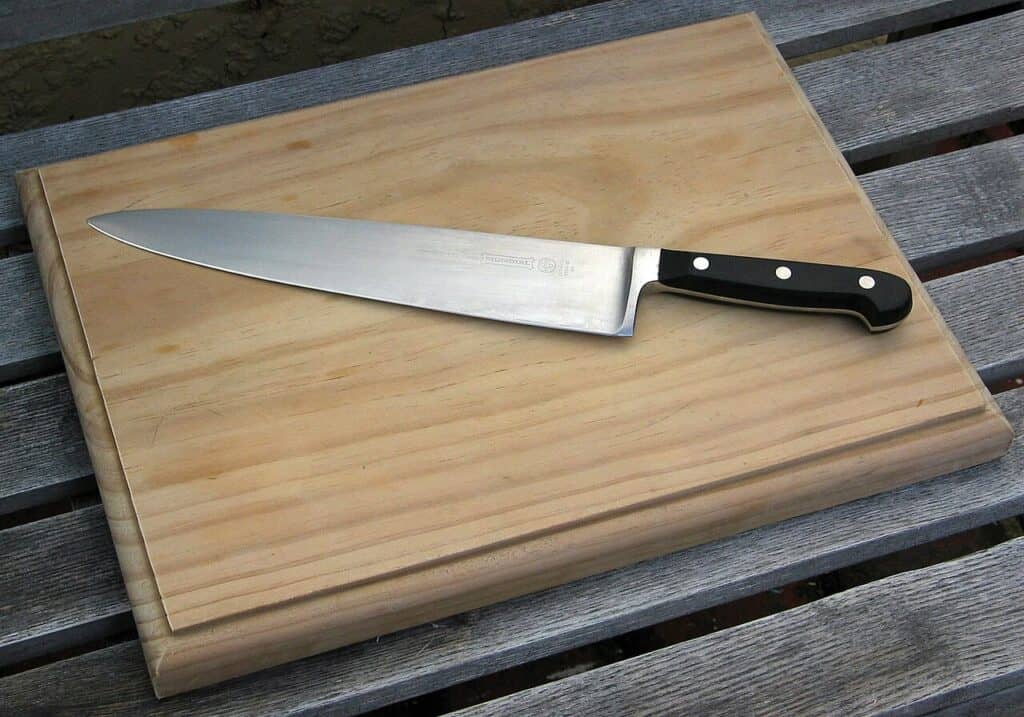
Photo: Donovan Govan; tonal adjustment by BlueBreezeWiki · CC BY-SA 3.0. Display size adjusted; no cropping.
Wood: Choose the Board and Its Care Instructions Together
Wood is a broad category. End-grain, edge-grain and hinoki boards should not be given an identical care prescription, and this guide does not claim that every end-grain board outperforms every alternative. Match the particular product to the time and space you have for cleaning and drying.
For the Shun DM0816, the maker instructs users to wet the surface before use, wash with mild detergent, towel-dry and then air-dry away from direct sunlight. It must not go in the dishwasher. Those are the relevant instructions for this example; “oil every wooden board monthly” is not a substitute for them.
Choose this option if: you want a comparatively compact board and will hand-wash it. Consider another size if: a long knife or a large pile of chopped vegetables crowds the working surface. Mark out the listed dimensions on your counter before purchasing.
Plastic: Convenience Depends on the Exact Model
The OXO example is polypropylene, with a reversible surface, a juice groove and non-slip feet, and its manufacturer says it is dishwasher-safe. Its large footprint is useful to compare with a compact board, but dishwasher-safe does not mean it will fit your dishwasher. Check the rack before choosing a board mainly for machine cleaning.
Do not extend one product’s dishwasher claim to all plastic boards. Thin flexible mats, thick commercial boards and a home carving board are different products. Inspect the surface over time and replace boards with damage or grooves that cannot be cleaned effectively.
Soft Synthetic and Composite Boards Are Not One Material
Hasegawa’s Pro-Soft uses a soft surface over a wood core. The maker lists the FSR20-6030 at 2.4 kg and 600 × 300 mm, with dishwasher compatibility. Follow its temperature and care limits. Those specifications apply to this series, not every rubber-like or composite board sold under a similar description.
Compared with the compact hinoki example, this is a much larger, heavier object to move around the kitchen. Choose it only if the extra working area is useful and there is a suitable drying and storage location. A paper composite, solid rubber board and wood-core board should each be checked separately rather than treated as interchangeable upgrades.
Cleaning and Food Separation Matter More Than Marketing Labels
USDA guidance advises washing after each food item, using a separate board for raw meat, poultry and seafood where possible, and replacing excessively worn boards or those with hard-to-clean grooves. “Antibacterial” branding does not remove the need for cleaning. Follow food-safety guidance and the manufacturer’s compatible cleaning method together.
A two-board setup can be practical: one appropriate surface for produce and a separately used, easily cleaned board for raw foods. Pick sizes you will actually wash immediately rather than keeping an oversized board permanently on the counter because it is difficult to move.
A Five-Minute Buying Checklist
Fit: compare the whole-board dimensions with your available worktop. Handling: consider the listed weight when lifting a wet board. Cleanup: confirm the exact dishwasher or hand-wash instruction. Drying: identify a ventilated place to let the board dry. Replacement: budget for replacing a damaged surface rather than treating any board as permanent.
There is no reliable universal timetable for sharpening based only on board material. If the knife drags or the edge is damaged, review both technique and edge condition. The Japanese knife steel comparison explains why the steel name alone cannot predict maintenance intervals.
Which Board Should You Buy First?
For a small kitchen with hand-washing, start by checking the Shun’s compact dimensions. For dishwasher convenience and more room, compare the OXO against your rack and sink. For a large soft synthetic surface, consider the Hasegawa only after checking its footprint and weight. None is an automatic winner for every cook.
Complete the setup with the Japanese kitchen knife buying guide, sharpening basics and knife storage comparison. Choose the combination you can maintain consistently, rather than selecting an expensive blade and treating the board as an afterthought.
Pair a suitable board with edge maintenance
A board choice does not replace sharpening. If your knife is already dull, use the whetstone selection guide to compare grit, wetting instructions and upkeep before buying another stone.