Japanese Notebook Sizes: Find the Right Cover Fit
Affiliate disclosure: As an Amazon Associate I earn from qualifying purchases. Product links below lead to Amazon.com.
Japanese notebook sizes are useful starting points, but cover fit depends on actual height, width and thickness. Measure the complete closed notebook and compare those figures with the accessory maker’s supported dimensions.
When buying a cover or accessory, compare the notebook's complete dimensions, including thickness. A label that resembles a paper size does not establish that every cover with that label will fit.
For the standard paper dimensions below, see Epson’s paper-size reference and its international B5 distinction. Notebook covers and bindings can extend beyond the paper format.
Japanese notebook sizes in millimetres and inches
Compare height × width first, then thickness and the cover maker’s fit allowance. The inch figures below are rounded conversions, not separate product specifications.
| Format or actual product | Height × width (mm) | Approx. inches | Cover-fit implication |
|---|---|---|---|
| A5 / MD Notebook A5 | 210 × 148 | 8.27 × 5.83 | Current MD example is 10 mm thick; other A5 books vary |
| A6 | 148 × 105 | 5.83 × 4.13 | Check notebook thickness and binding |
| JIS B5 | 257 × 182 | 10.12 × 7.17 | Larger than ISO B5 |
| ISO B5 | 250 × 176 | 9.84 × 6.93 | Not the same as Japanese B5 or semi-B5 |
| JIS B6 | 182 × 128 | 7.17 × 5.04 | Not the same as B6 Slim |
| Kokuyo Good Tools semi-B5 | 252 × 179 | 9.92 × 7.05 | A real product size between ISO and JIS B5 |
| MD B6 Slim reference | 175 × 105 | 6.89 × 4.13 | Do not choose a full B6 cover on the name alone |
| Traveler’s Notebook Passport lined refill | 124 × 89 | 4.88 × 3.50 | A proprietary refill format, not A6 |
Manufacturer references: MD Notebook A5, Designphil format specifications, Kokuyo semi-B5 notebook and Traveler’s Passport refill. Sizes describe these models; ring bindings, hard covers and thicker editions can change the outer dimensions.
Example: why “B5” is not enough
A sleeve made tightly around a 250 × 176 mm ISO B5 book cannot be assumed to fit a 252 × 179 mm semi-B5 notebook, even before allowing for thickness. Ask for the maximum supported book dimensions, not just the cover’s outside measurement. For an elastic refill system, also match how the booklet is held.
Japanese notebook sizes: start with the object you carry
Measure your current notebook closed: height, width and thickness. Include a projecting binding or tabs if they affect how it fits your bag. Then measure the usable space in the pocket or pouch where you intend to keep it.
If you are choosing your first notebook, cut a paper rectangle to the candidate's listed height and width. Fold or stack scrap paper to approximate the thickness. This is a space-planning exercise, not a substitute for testing the binding or paper.
| Measurement | Where to find it | What it helps prevent |
|---|---|---|
| Closed height and width | Product specifications | A notebook too large for the intended pocket |
| Thickness | Product specifications or seller confirmation | A cover that cannot close comfortably |
| Cover's supported dimensions | Accessory listing | Assuming compatibility from a size name |
| Space with a pen attached | Your own measurement | A setup wider than expected |
A real A5 example: same label, different cover compatibility
The MD Notebook Clear Cover A5, 35661006 provides a concrete example. Its official compatibility list includes the standard MD Notebook A5, but explicitly excludes the A5 one-day-one-page notebook and one-day-one-page diary. An A5 label therefore does not settle the choice even within one product family.
| Published detail | How to use it |
|---|---|
| Cover size: 216 × 315 mm when open | This is the opened cover measurement, not the maximum closed notebook size it accepts. |
| Standard MD Notebook A5: 210 × 148 × 10 mm | Match the named edition and model; do not transfer every specification to older stock. |
| A5 one-day-one-page books excluded from this cover | Look for the cover made for that variant rather than forcing it into the standard cover. |
| Pen holder internal diameter: 10 mm | Compare the intended pen and clip arrangement; a nominal pen-body width alone is not a tested fit. |
Checked against the maker’s pages on November 20, 2026. This is a published-specification example, not a physical fitting test or a new affiliate recommendation. The older 15293006 notebook linked below and the current 15384006 blank notebook are different editions; ask the seller to confirm the actual item.
A cover-fit enquiry you can copy
“My notebook is [maker, model, year/layout], with closed dimensions [height × width × thickness]. Does cover [model] explicitly support this version, including its binding and closure? Are the dimensions you list for the open cover or the notebook it accepts?”
Keep the answer with your reorder details. For calendar and refill-system choices, use the planner routine comparison; for paper behaviour, compare the exact notebook in our fountain-pen notebook guide.
Product dimensions can differ from the shorthand
MIDORI's diary specifications list dimensions for individual products, including variants within its range. Read those figures instead of assuming that every “B6” or “slim” notebook has the same external footprint.
This matters most when reusing an existing cover. Compare the new notebook against the cover manufacturer's supported dimensions and construction, not just against the old notebook's advertised size.

Photo: Jeff Sheldon ugmonk / Wikimedia Commons · CC0 1.0. Resized/compressed; no content edits.
Choose a page layout around your task
Draw a rough version of your most common page: a meeting note, a day's plan or a travel entry. Notice how much writing space you actually need. If you frequently paste tickets or foldouts, allow for the thickness those additions create over time.
For desk use, a larger writing area may be convenient. For notes while standing, carrying comfort and how easily the book opens may matter more. These are personal trade-offs; “pocket size” is only useful if it fits your pocket.
Check accessories independently
MIDORI's accessory page describes adjustable bands and bookmarks with their own fitting guidance. Accessories can be adjustable, but that does not mean every band, pen loop or cover is universal.
Consider the pen as part of the setup. Check its width against a loop's stated capacity, and account for the extra bulk before buying a case. Avoid ordering several accessories until you know which problem each one solves.

Photo: Shixart1985 / Wikimedia Commons · CC BY 2.0. Resized/compressed; no content edits.
Compare imported versions by specifications
For US, UK, Australian and Canadian shoppers, use millimetres as a common reference when listings mix metric and imperial units. Check whether the price is for a notebook, a cover, a refill or a bundle. Product photographs sometimes show accessories that are not included.
Your final checklist is short: dimensions, thickness, layout, included items and accessory compatibility. Save those details for your next refill purchase. A useful notebook system is one you can replace and keep using, not just one that looks appealing in a photograph.
Compare paper and binding choices in our Japanese notebooks for fountain pens guide. For a dated planner or refillable travel system, see our Hobonichi Techo versus Traveler’s Notebook comparison.
Frequently asked questions
Does a matching size label guarantee cover fit?
No. Compare actual external dimensions and the cover’s supported notebook thickness and construction. A nominal paper size does not describe every projecting binding, tab or outer cover. Check the exact notebook model when reusing an accessory you already own.
How can I compare sizes without buying both?
Make paper outlines from the listed dimensions and place them on your desk or in the bag pocket you will use. Approximate the thickness with scrap paper. This helps compare carrying space, although it cannot reproduce paper feel, binding behaviour or how comfortably the notebook opens.
Editorial approach: This guide uses the manufacturer or operator sources linked above. It is not a hands-on review. Confirm the current instructions for the exact product before purchasing.
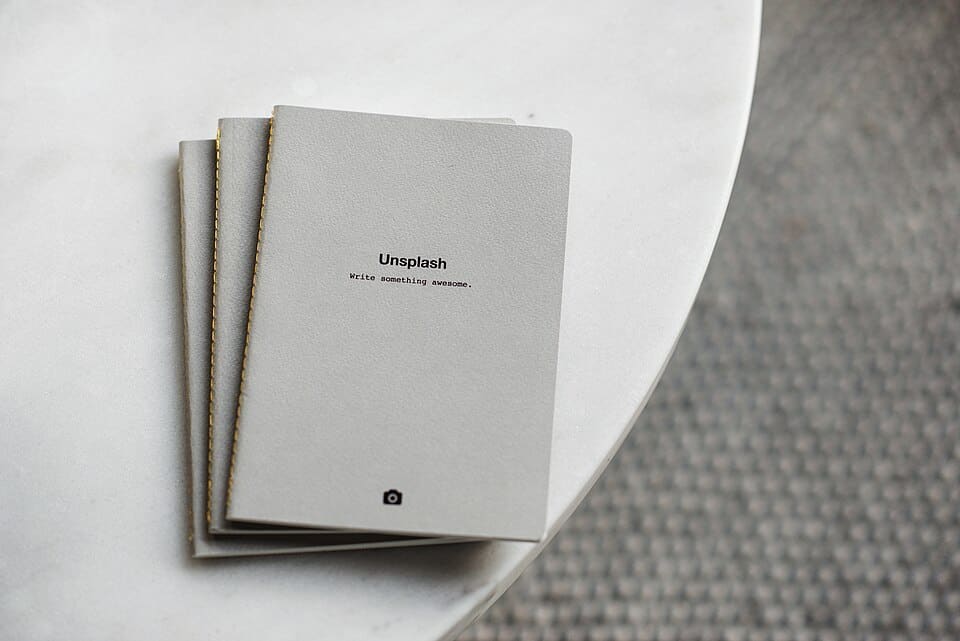
Featured image: A stack of slim notebooks on a light surface. Illustrative photograph. Photo: Baron Fig baronfig / Wikimedia Commons · CC0 1.0. Resized/compressed; no content edits.